logo
EN
IT
FR
DE
ES
logo
EN
IT
FR
DE
ES
scheduled

Alain Urrutia | ABIAPUNTUA

From 8 November to 14 February 2027

Maramotti collection

Maramotti collection

Via Fratelli Cervi, 66, Reggio Emilia

Closed today: open tomorrow at 14:30

Verified profile
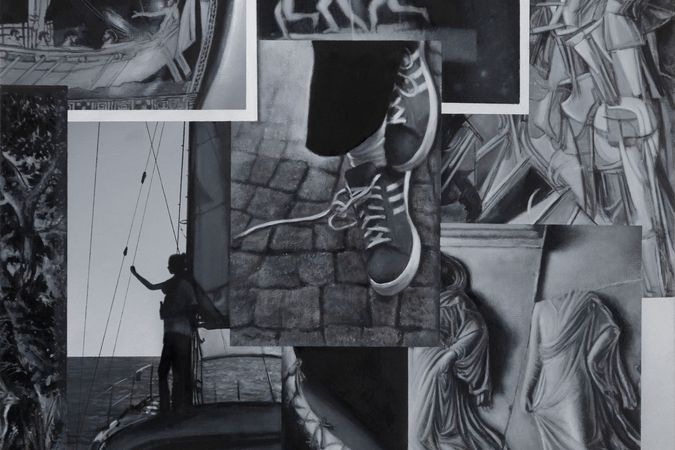

I carry forward the idea of revealing just enough to show that there are things destined to remain hidden. Alain Urrutia
ABIAPUNTUA is the title of the extensive exhibition project conceived by Alain Urrutia for the Collezione Maramotti, his first solo show in an institutional space in Italy. Urrutia chose Euskara, the language of the Basque Country where he was born and raised, as the starting point (abiapuntua) conceptually to initiate a corpus of over twenty new paintings - strictly in black, white, and shades of gray - accompanied by two videos. 
A collector of images, deeply interested in the mental and visual construction of representation, Urrutia explores the meaning and memory of objects and subjects drawn from art history, everyday life, cinema, photography, and the vast iconographic repertoire collected in his personal archive - a living organism, a digital atlas in the form of constellations that is shared with the public for the first time here. 
The exhibited works trace the trajectory of an endless and uninterrupted research, the map of an iconographic and sentimental journey through nine universal themes intertwined in a circular path, where the origin meets revelation, crossing nature, community, myth, word, power, and death. The exhibition is organized in three separate and connected spaces of the Collection, giving life to three distinct nuclei in mutual dialogue. On the entrance wall, nine small canvases welcome the outcomes of Urrutia's explorations navigating his own archive: nine distilled images, nine points of arrival that condense, by fixing them in a detail, the essential themes that underlie the artist's reflections - and that have accompanied humanity in every era. What subject to choose to represent the origin, creation, the generation of life? In what form to deliver the ritual and mythological heritage of the world? How to bring out on the canvas, in a few strokes, the dreamlike essence of the end? Urrutia formulates personal answers in the form of painting: works born from a meticulous technique, but open and porous in interpretation, leaving the observer full freedom on the thread of individual feeling. 
In the adjacent rooms, in a sort of backward path, the genesis process of these nine small paintings is returned. Each of them derives from a specific moodboard, a pictorial collage of images clustered around the same macro-theme, ideally related to the panels of Aby Warburg's Bilderatlas Mnemosyne. The German art historian sought to collect and organize in this project - left unfinished at his death in 1929 - the iconographic expressions that could constitute the "formulas of pathos" (Pathosformeln): figures and models, recurring schemes and postures in the process of cultural transmission and always resurfacing throughout history, from antiquity to the present. Urrutia develops his visual panels as combinations of clues, aggregating and fragmenting pre-existing images extracted from his archive. Flowers, faces, eyes, feathers, snakes, clouds, chess, playing cards, references to Courbet, Botticelli, Bernini, Duchamp: in a compositional construction that proceeds through juxtapositions, superimpositions, concealments, overflows, and slippages, the artist challenges the integrity of reading references, questioning the limits and possibilities of expanding vision, together with the capacity of memory persistence. 
The same approach, amplified, is also traceable in the large canvases, whose main significant features are the margins. In the hypertrophic horizontal development of images juxtaposed and accumulated on top of each other, whose frontal side is often denied to us, the edges assume a function of anchoring for the imagination of the multiple possibilities of figuration that the works are able to accommodate. The pictorially simulated tears in three iconic works for Urrutia further emphasize absence as a central, vital element, and of semantic development in the dialectic between visible and invisible, as expressed by the philosopher Georges Didi-Huberman. The void, or what lies outside the field of representation, which remains hidden, offers a prolific push to fill the gaps by the observer, continuously regenerating, thanks to imaginative activity, the sense of what is incomplete. Mystery, leaving space, encloses within itself a fertile and transformative force that, in Urrutia's work, acts simultaneously by accumulation and by subtraction. 
The two videos created for the project are configured as dynamic incursions with different rhythms and in different directions, through which flows the iconographic cosmogony of the artist's archive at the moment of forming this exhibition, inevitably destined for future metamorphoses. On the occasion of the exhibition, a book will be published with texts by Ada Naval, art historian, researcher, and curator, and by Giorgio Vallortigara, Professor of Neuroscience at CIMEC - Interdepartmental Center Mind/Brain of the University of Trento. 
With the invitation to Alain Urrutia, the Collezione Maramotti continues the long journey of exploration and public sharing of the work of emerging artists who, through the language of painting, conceive new bodies of work expanding personal research and practices in a broad project.
Read more

Info and hours

pointer icon

Via Fratelli Cervi, 66, Reggio Emilia, Italy

Open the map

Opening hours

opens - closes last entry
monday Closed now
tuesday Closed now
wednesday Closed now
thursday 14:30 - 18:30
friday 14:30 - 18:30
saturday 10:30 - 18:30
sunday 10:30 - 18:30

The visit to the permanent collection is accompanied, by reservation and reserved for a maximum of 25 visitors at a time. Starting times for visiting the permanent collection : Thursday and Friday 3.00 pm; Saturday and Sunday 10.30am and 3.00pm.

Access to the temporary exhibitions is free on Thursday and Friday from 2.30pm to 6.30pm; Saturday and Sunday from 10.30am to 6.30pm. 

The entire exhibition itinerary is accessible to people with mobility difficulties.

Closed: 1st and 6th January, 25th April, 1st May, 1st to 25th August, 1st November, 25th and 26th December. Free entry.

Jason Dodge's permanent installation, A permanently open window, can be visited upon request on Saturdays and Sundays at the following times: from April to September from 5pm to 6.30pm; from October to March from 1.00pm to 1.30pm and from 2.30pm to 3.00pm.


Other Scheduled Events

at Maramotti collection

Other Exhibitions

in Reggio Emilia