


About
In Cupra Marittima, along the SS 16, there are visible remains of a Roman seaside villa; the residential area of the villa, dating back to the 2nd century AD, was preceded by a rustic complex used for wine production which, in the 3rd-4th century AD, was replaced by a small thermal sector. Below the small pillars supporting the circular flooring, through which the heat was channeled (the suspensurae), there is still visible an element of the ancient torcularium used for pressing grapes. The opus spicatum flooring is what remains of the ara, where the harvest basket was placed. The torcularium dates back to the 1st century BC and coexisted for centuries with the villa until its final abandonment in the late antique period. In the lawn in front of the triclinium-nymphaeum, some large dolia from another villa found in Massignano are also visible. In the late period, between the late 3rd and 4th century AD, the villa was embellished with polychrome mosaic floors.
You can see: a room paved with a motif of small arches with two paired basins that, due to their size, allow to identify the frigidarium; two adjacent rooms, immediately to the west, the calidarium and tepidarium, with floor levels, one of which with a coffered mosaic, featuring the motif of the Solomon's knot.
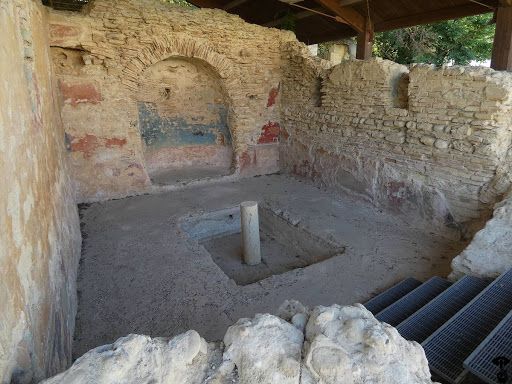
The villa was enclosed to the northwest by an open space, probably a garden, in which there was a nymphaeum, a room for decorative purposes intended for water games. The nymphaeum, a square room that originally faced the sea, had a pair of small niches on the long sides while the short back side was apsidal; a collection basin had been created in the lower part, completely painted in red.
The walls of the nymphaeum are entirely decorated with frescoes depicting motifs simulating a marble covering plinth at the bottom and monochrome yellow ochre and red tapestries. The decoration of the apse represents a marine scene: on a blue background, among marine and fantastic animals, there are small boats with fishermen. The painting dates back to the 2nd century AD, and seems to have subsequent touch-ups, concentrated in the plinth.
Programme and activities
Guided tours, exhibitions and events at Nymphaeum and Roman Villa of Cupra Marittima will appear here. Follow the museum to get updates.