About
It is called "The Dream of Marsia" and is the composition created by the Oscar-winning Maestro Dario Marianelli thinking of the National Archaeological Museum of Taranto - MArTA and the suggestions that the artistic residence in Taranto, with all its cultural and historical heritage, has aroused in the great composer.
The work can only be listened to by going to the Taranto Museum by connecting to a QR Code which will give access. that the artistic residence in Taranto, with all its cultural and historical heritage, has aroused in the great composer.
The work can only be heard by going to the Tarantino Museum by connecting to a QR Code that will give access to the musical experience.
But how did the musical project signed by Marianelli come about? It's called "Il Sogno di Marsia" and it is the composition created by the Oscar-winning Maestro Dario Marianelli thinking of the National Archaeological Museum of Taranto - MArTA and the suggestions that the artistic residency at Taranto, with all its cultural and historical heritage, aroused in the great composer.
The work can only be heard by going to the Tarantino Museum by connecting to a QR Code that will give access to the musical experience.
But how did the musical project signed by Marianelli come about?
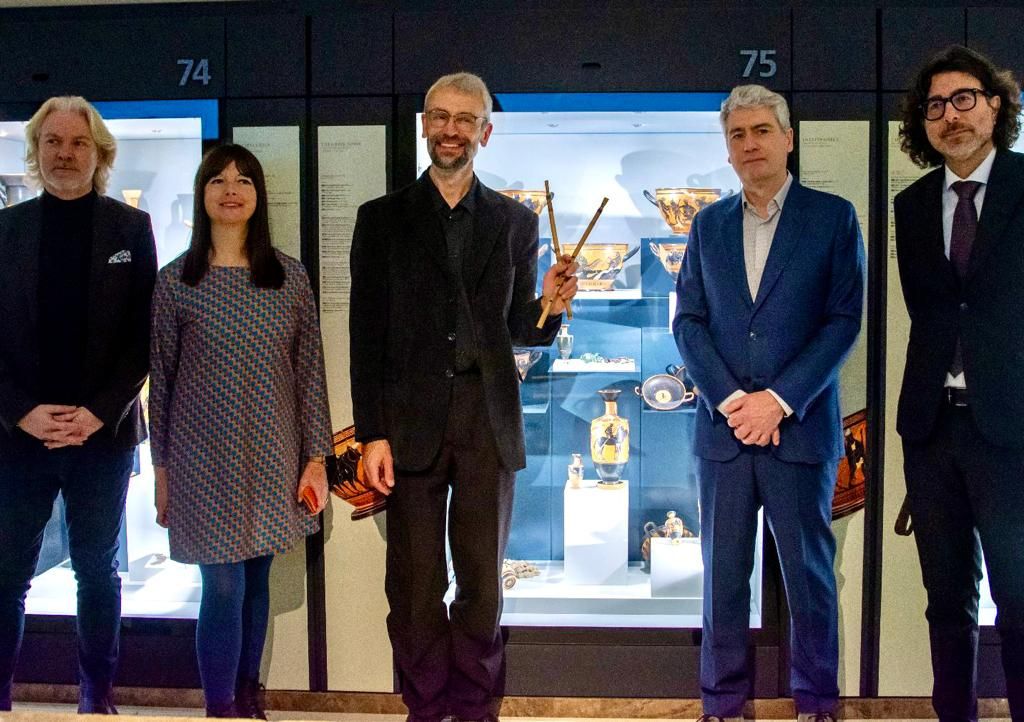
It is a suggestion that came after a journey through the halls of the Museum, finding inspiration in the aulos: an ancient instrument also present in the images imprinted on the Panathenaic amphorae of the Taranto Museum.
“The idea of bringing back to life the sound of an instrument that hasn't been heard for 1500 years – commented the composer Dario Marianelli – was the great inspiration. Observing these silent instruments that are a feast for the eyes when observed in museums, seemed to me a great opportunity to give voice to the aulos whose executive and construction technique had been lost”. From this choice was born the involvement of maestro Barnaby Brown, "an expert in musical archeology - said the director Eva Degl'Innocenti - who in studying and researching this instrument used a method of evidence that archaeologists use for the activities of Research".
And for the first time in history, a piece for aulos and orchestra was written. “We had to reinvent the technique to be able to control the pitch of the notes in a stable way and to be able to work with an orchestra” – said maestro Marianelli.
The aulos was also used in Dionysian rituals, for orgiastic celebrations; it was a tool associated with extemporaneousness. It was used to mark the time in sports competitions. “Moreover, music was part of the education of the young people of the Greek Taranto. According to Plato, the aulos is also associated with possessive phenomena and the melodies played with this instrument alone, due to their divine power, transport souls into a frenzy” added Eva Degl'Innocenti.
“Probably because, unlike the lyre, another common instrument in Magna Graecia, which tunes for every scale, the aulos has the notes in a very strange position and the auleta must construct them by bringing the reeds into positions useful for changing the height of the note” specified the composer Dario Marianelli.
It is a suggestion that came after a journey through the halls of the Museum, finding inspiration in the aulos: an ancient instrument also present in the images imprinted on the Panathenaic amphorae of the Taranto Museum.
“The idea of bringing back to life the sound of an instrument that hasn't been heard for 1500 years – commented the composer Dario Marianelli – was the great inspiration. Observing these silent instruments that are a feast for the eyes when observed in museums, seemed to me a great opportunity to give voice to the aulos whose executive and construction technique had been lost”. From this choice was born the involvement of maestro Barnaby Brown, "an expert in musical archeology - said the director Eva Degl'Innocenti - who in studying and researching this instrument used a method of evidence that archaeologists use for the activities of Research".
And for the first time in history, a piece for aulos and orchestra was written. “We had to reinvent the technique to be able to control the pitch of the notes in a stable way and to be able to work with an orchestra” – said maestro Marianelli.
The aulos was also used in Dionysian rituals, for orgiastic celebrations; it was a tool associated with extemporaneousness. It was used to mark the time in sports competitions. “Moreover, music was part of the education of the young people of the Greek Taranto. According to Plato, the aulos is also associated with possessive phenomena and the melodies played with this instrument alone, due to their divine power, transport souls into a frenzy” added Eva Degl'Innocenti.
“Probably because, unlike the lyre, another common instrument in Magna Graecia, which tunes for every scale, the aulos has the notes in a very strange position and the auleta must construct them by bringing the reeds into positions useful for changing the height of the note” specified the composer Dario Marianelli.it to the musical experience.
But how did the musical project signed by Marianelli come about?
It is a suggestion that came after a journey through the halls of the Museum, finding inspiration in the aulos: an ancient instrument also present in the images imprinted on the Panathenaic amphorae of the Taranto Museum.
“The idea of bringing back to life the sound of an instrument that hasn't been heard for 1500 years – commented the composer Dario Marianelli – was the great inspiration. Observing these silent instruments that are a feast for the eyes when observed in museums, seemed to me a great opportunity to give voice to the aulos whose executive and construction technique had been lost”. From this choice was born the involvement of maestro Barnaby Brown, "an expert in musical archeology - said the director Eva Degl'Innocenti - who in studying and researching this instrument used a method of evidence that archaeologists use for the activities of Research".
And for the first time in history, a piece for aulos and orchestra was written. “We had to reinvent the technique to be able to control the pitch of the notes in a stable way and to be able to work with an orchestra” – said maestro Marianelli.
The aulos was also used in Dionysian rituals, for orgiastic celebrations; it was a tool associated with extemporaneousness. It was used to mark the time in sports competitions. “Moreover, music was part of the education of the young people of the Greek Taranto. According to Plato, the aulos is also associated with possessive phenomena and the melodies played with this instrument alone, due to their divine power, transport souls into a frenzy” added Eva Degl'Innocenti.
“Probably because, unlike the lyre, another common instrument in Magna Graecia, which tunes for every scale, the aulos has the notes in a very strange position and the auleta must construct them by bringing the reeds into positions useful for changing the height of the note” specified the composer Dario Marianelli.