About
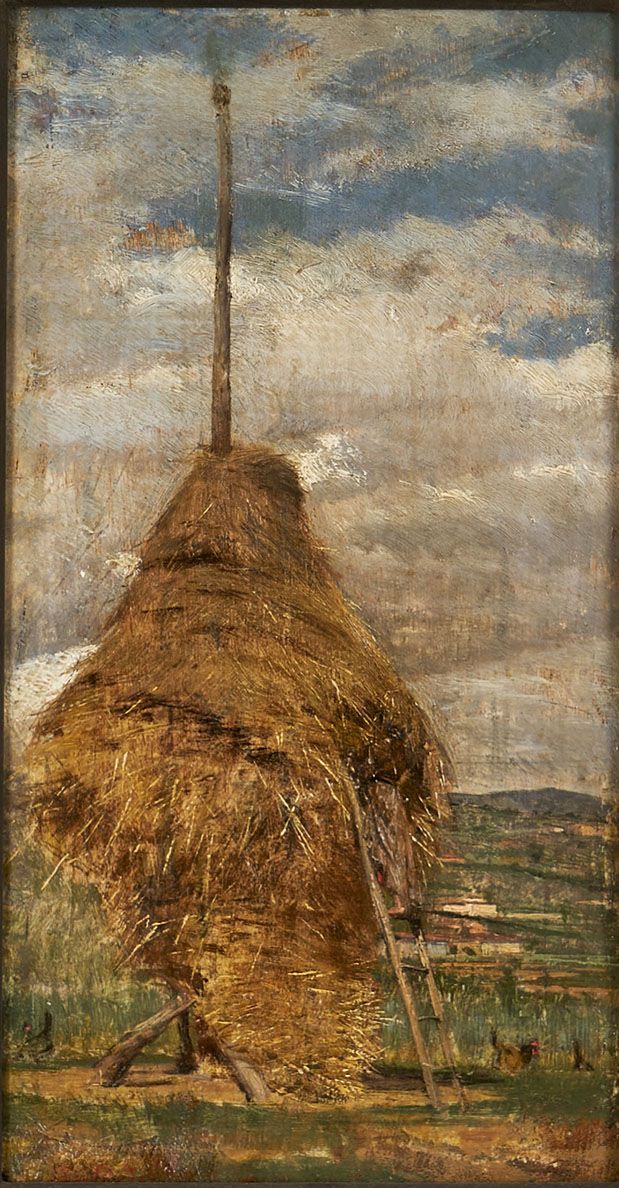
The collections of the Museum of the Ancient Bishops' Palace in Pistoia, entrusted to the care of Fondazione Pistoia Musei, are enriched with a new masterpiece. It is Il Pagliaio by Giovanni Boldini (1842-1931), a small oil on panel acquired by Fondazione Caript, depicting a haystack immersed in the summer light of the Tuscan countryside.
Il Pagliaio by Giovanni Boldini is a significant piece for the study of the famous mural temperas executed by the Ferrarese artist in the summer of 1868 at Villa Falconer in Collegigliato, in the Pistoia countryside. Acquired in 1974 by the Cassa di Risparmio di Pistoia e Pescia, the works now owned by Collezione Intesa Sanpaolo have been rearranged inside the Ancient Bishops' Palace in a layout faithful to the original one and can be visited as part of the museum's exhibition path.
The small panel (19 x 10 cm) recently acquired reproduces the same subject painted on the west wall of the dining room of the villa: a direct and documented connection with the mural cycle commissioned by Isabella Robinson Falconer. A "portable" work, therefore, that testifies to the direct observation with which Boldini approached that decorative project.
The arrival of Il Pagliaio not only increases the nucleus of Boldini's works already housed in the museum, but also strengthens the bond between art, collecting, and the history of the territory. A reconstructed page that contributes to a broader view of the young artist's activity, still far from the worldliness of the Belle Époque, but capable of capturing the poetry of everyday reality.
The value of this small masterpiece, however, goes well beyond the iconographic reference. The painting comes from the private collection of Cristiano Banti, a central figure of the Macchiaioli movement. Indeed, it was to Banti that the young artist entrusted many of his panels executed in Tuscany between Florence, Castiglioncello, and the Pistoia countryside, before leaving for Paris in 1871.
The painting is therefore a direct testimony of Boldini's Tuscan phase, a period often overshadowed by his Parisian celebrity but far from secondary, in which he experimented with light, material, and painting from life, in close dialogue with the Macchiaioli painters.