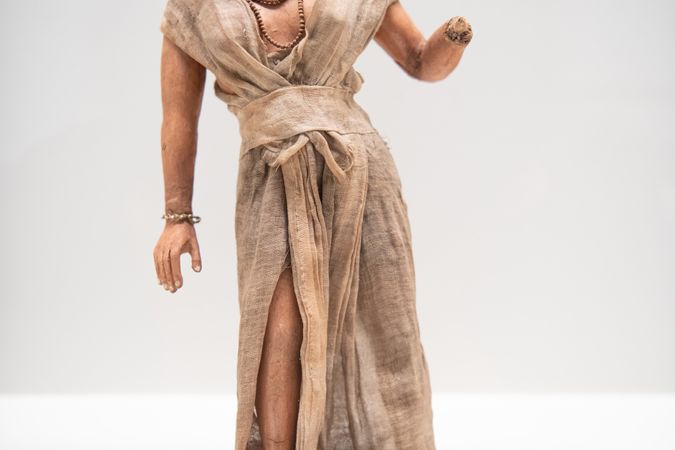
The artifact is part of a larger nucleus, consisting of sixteen statuettes made of clay and fabric, very homogeneous in size, workmanship and style, and which would seem to represent a group of players and dancers accompanied by torch-bearers and crowbars. The somatic features reproduced, for the most part Dravidian, refer to the southern area of India. This geographical belonging is confirmed by the type of clothing worn. The production of this type of artifact, in vogue in the nineteenth century in the Krishnagar area in West Bengal, was entrusted to communities of potters, and was made both for religious purposes and as toys and household items. In addition to baked clay, Bengal artisans often used jute, metal, wood and palm leaves.
The work "Indian statuette" is kept at Palace of Museums - Varallo Art Gallery and Calderini Museum, in Varallo.
"Indian statuette" is a work from nineteenth century made with the technique "Clay".
You can admire the work in the collection of Palace of Museums - Varallo Art Gallery and Calderini Museum. Artsupp Card holders get reductions and dedicated benefits.