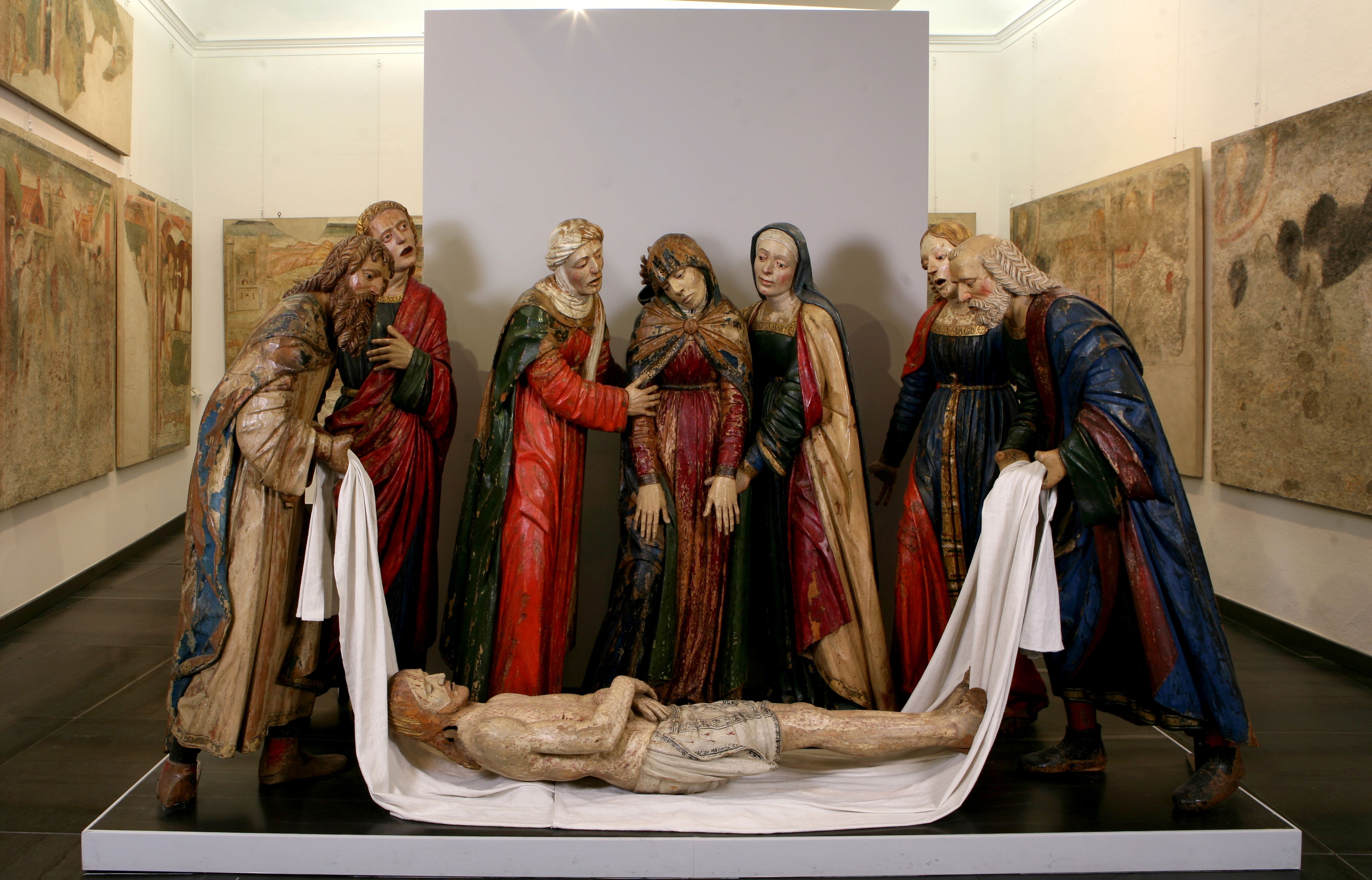
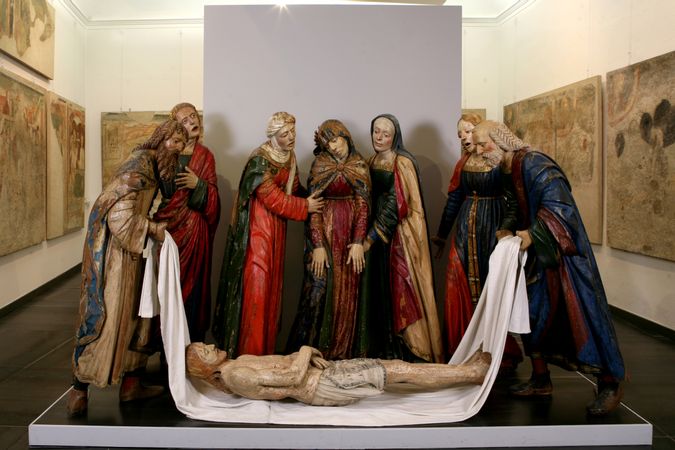
The wooden group of the Anointing Stone comes from the oldest nucleus of the Sacro Monte di Varallo. The chapel that originally housed the sculptures was part of the project of imitation of the Holy Places initiated by the Franciscan Bernardino Caimi and intended to evoke the place, marked by a stone placed in the basilica of the Holy Sepulcher in Jerusalem, in which the anointing of the body of Christ before his burial. The group, referring to the Lombard workshop of the brothers Giovanni Pietro and Giovanni Ambrogio De Donati (documented between about 1470 and 1530), among the most active in the Milanese dukedom at the end of the fifteenth century, is among the most important sources for the young Gaudenzio Ferrari , which takes him as a point of reference in his first pictorial works, such as the table with the Crucifixion, always in the museum collections. The profound psychological analysis of the characters, who mute an inner drama, is the product of a refined culture, which translates emotions into simple volumes and into suspended gestures and glances.
The work "Lamentation over the body of Christ "Stone of Anointing"" is kept at Palace of Museums - Varallo Art Gallery and Calderini Museum, in Varallo.
"Lamentation over the body of Christ "Stone of Anointing"" is a work from 1486 - 1493 made with the technique "carved, painted and gilded wood".
You can admire the work in the collection of Palace of Museums - Varallo Art Gallery and Calderini Museum. Artsupp Card holders get reductions and dedicated benefits.